Investment Magazine / Special Report
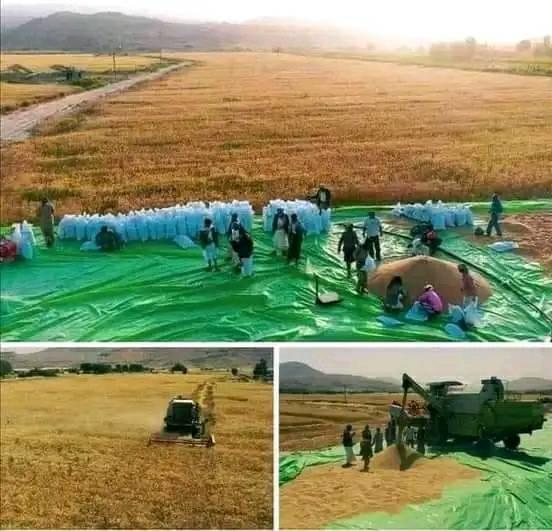
Al-Jawf Governorate in Yemen is witnessing an unprecedented agricultural revival in wheat production, driven by the proactive efforts of private sector investment companies. This marks a promising signal of fertile ground for attracting further investors to cultivate this vital food crop.
According to data monitored by Investment Magazine, affiliated with the General Investment Authority – Headquarters in Sana’a, the 2024–2025 agricultural season has achieved remarkable qualitative and quantitative progress. Cultivated wheat areas expanded to 12,000 hectares—an impressive 40% growth compared to the previous season. This production leap would not have been possible without the successful model of private Yemeni investments and a strong public-private partnership that laid the foundation for sustainable agricultural development.
The private sector is playing a pivotal role in this transformation by making targeted investments across the agricultural value chain. It directly contributed to improving agricultural input packages, providing over 160,000 bags of high-yield improved seeds. These seeds have tripled productivity in some farms. Additionally, private companies have developed an integrated quality assurance system, including soil analysis laboratories, seed treatment units, and farmer training centers on modern techniques.
Field data shows that private investment in Al-Jawf’s agricultural sector grew by 35% this year, spanning several critical areas. These include the establishment of 12 organic fertilizer production units, five agricultural equipment maintenance centers, three solar-powered smart irrigation projects, and the launch of the governorate’s first integrated grain supply chain.
Promising Outcomes
On the technical front, the introduction of precision farming in large-scale farms has already begun to yield promising results. These farms have reported a 45% increase in productivity and a 30% reduction in irrigation water usage. The application of agricultural tracking systems has also enhanced crop quality and market value.
The strategic importance of wheat cultivation in Al-Jawf lies in Yemen’s annual wheat import bill of $1.2 billion. Al-Jawf alone has the potential to cover 25% of this gap if its full agricultural capacity is harnessed effectively. Studies show the governorate has over 50,000 hectares suitable for wheat cultivation, with the potential to yield up to four tons per hectare using modern technologies.
Local Economic Impact
Private agricultural investments are beginning to positively impact local development. Over 1,500 direct job opportunities have been created, alongside the growth of small and medium-scale food industries. These developments have boosted commercial activity in local markets, helped stabilize rural communities, and reduced migration.
Looking ahead, the vision is to transform Al-Jawf into a regional wheat production hub. Investment opportunities abound, including the development of an integrated agricultural industrial zone, the establishment of a specialized grain research and development center, the creation of an agricultural commodities exchange, and the expansion of smart infrastructure to support supply chains.
Al-Jawf’s wheat success story stands as a promising model worthy of greater support and development. Beyond strengthening food security, the sector has the potential to become a key driver of economic and social development in the governorate. Achieving this vision will require fostering greater trust between the public and private sectors, streamlining investment procedures, and crafting supportive policies for modern agriculture—paving the way for Yemen to reach new milestones in food security and sustainable development.
Comments