Investment Magazine / Special
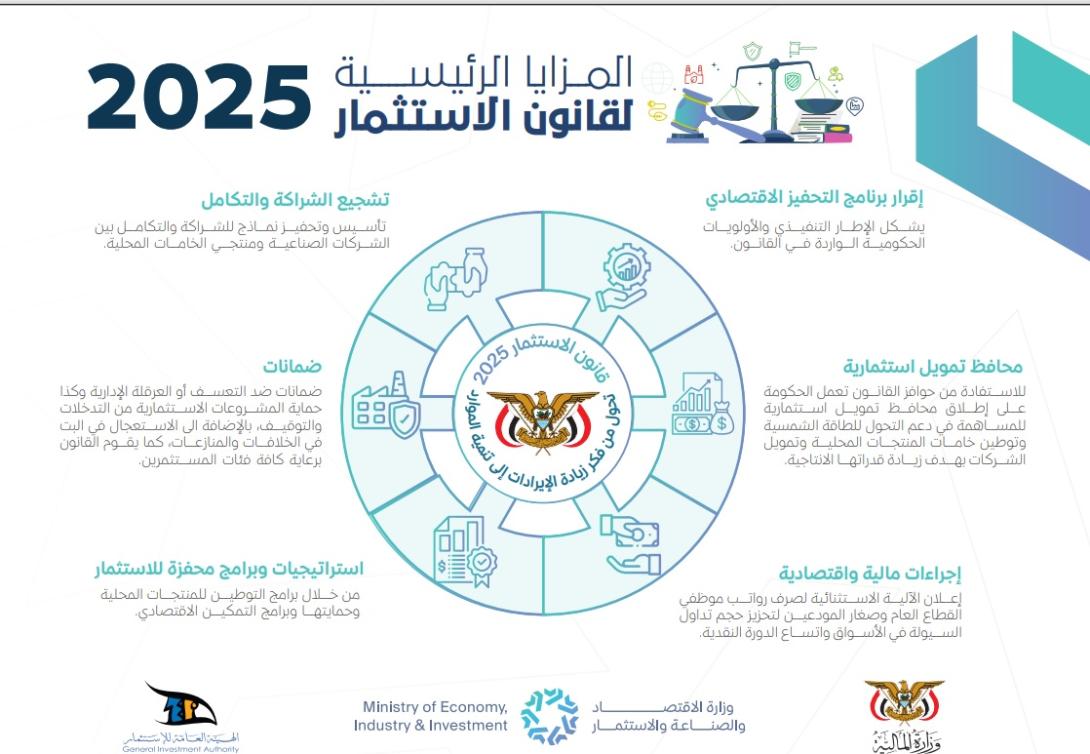
The economic stimulus program launched by the government of change and construction in Yemen since November 2024 strengthens the investment environment in Yemen by combining investment incentives for investors and preparing the investment environment itself and providing it with multiple advantages included in the new Investment Law 2025, which became a reality for implementation in all governorates since the official launch of the law in early February 2025.
Today, the economic stimulus program is considered the main pillar of the government's strategy to achieve sustainable development and reduce dependence on imports, according to H.E. Minister of Economy, Industry and Investment Engineer Moeen Al-Mahakri.
The program was launched in conjunction with the launch of the new investment law, reflecting an integrated vision for the advancement of the national economy.
What is the economic stimulus program?
Minister Al-Mahakri explained that the Economic Stimulus Program is a comprehensive program of the Government of Change and Construction, primarily aimed at managing value chains and reducing the import bill. He stressed that all the government's current economic programs and initiatives stem from this ambitious program, which was approved at the previous government session.
Components of the economic stimulus program:
The economic stimulus program includes fourteen diverse projects that cover vital aspects of the national economy. These projects include:
Stimulating the investment environment:
The recently launched new investment law is a key output of this component, which aims to improve the investment climate and attract local and foreign capital.
Localizing industries and supporting local products:
The program focuses on localizing manufacturing industries and supporting national products in various sectors, including pharmaceutical, food, agricultural, textile, leather, and other industries. Initiatives have already begun to localize some industries such as gauze and medical cotton.
Supporting electric and renewable energy products:
The program pays special attention to supporting solar and renewable energy as an alternative to fossil-fueled electricity, with the aim of reducing the cost of production and improving the competitiveness of local products. This sector has witnessed an influx of investors and a decrease in the cost of producing one megawatt.
Infrastructure projects:
The program opens prospects for investment in basic infrastructure such as roads, tunnels, bridges, power plants, and ports, with the opportunity for the private sector to participate in their construction, operation, and equipping.
Streamlining procedures and automating government services: The program included measures to facilitate the investment environment by extending the validity of commercial registers, merging commercial and industrial registers, and launching electronic portals for the Ministry of Economy, the Standards and Metrology Authority, and the Ministry of Finance to automate services and reduce bureaucracy. Work is also underway to electronically link the General Authority for Investment (GAFI) and the Customs Authority to facilitate investors' procedures.
Improving the competitiveness of local products:
The program seeks to improve the competitiveness of local products against imports by supporting production and reducing production costs, especially in light of the shift towards solar energy.
Import management and rationalization:
The program aims to manage and regulate the import process and focus on supporting local production to meet market needs and reduce the import bill, which reached about $11 billion in 2023.
The importance of the economic stimulus program:
The importance of the economic stimulus program lies in the fact that it represents an integrated strategic vision to advance the Yemeni economy in light of the current challenges. It aims to:
- Achieve self-sufficiency in many basic commodities and reduce dependence on imports, saving hard currency and enhancing food security.
- Stimulate local investments and direct national capital towards the productive and industrial sectors.
- Creating new job opportunities and contributing to solving the unemployment issue by supporting projects and expanding economic activities.
- Improving the business environment and providing an attractive climate for local and foreign investments by facilitating procedures and providing incentives.
- Strengthening the partnership between the private sector and the government in achieving economic development.
- Building a strong national economy capable of competing in local and regional markets.
In conclusion, the economic stimulus program is a pivotal tool in Yemen's efforts to build a prosperous economic future that relies on local production and reduces foreign dependence. Achieving the goals of this program requires the concerted efforts of the government and the private sector to overcome the challenges and obstacles that may stand in its way.
Comments