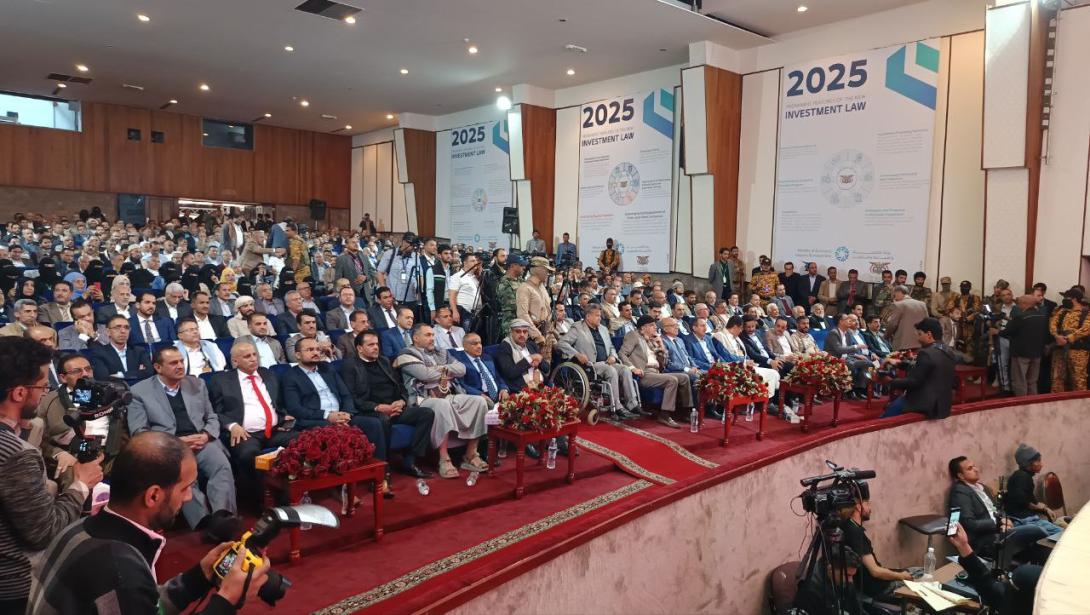
The Government Officially Launches Investment Law No. 3 of 2025
Investment Magazine/Exclusive
In the largest economic event to date, and under the slogan "Investing in Yemen... A New Vision," the Yemeni government officially launched the new Investment Law No. 3 of 2025 on Saturday, February 1, 2025, in a major celebratory event held in Sana’a. The event was attended by Prime Minister Ahmed Ghaleb Al-Rohawi, Deputy Prime Minister for Defense and Security Affairs, Ministers of Economy, Industry, Investment, Finance, Agriculture and Irrigation, the Chairman of the General Investment Authority, along with several government officials, businesspeople, and investors.
The new law, which has now come into effect, aims to improve the investment climate and attract both local and foreign capital. It represents a crucial step toward achieving economic development in the country.
During the launch, Prime Minister Al-Rohawi confirmed that the law is a significant step to encourage investment and support local production in Yemen. He emphasized the government's readiness to implement it and its commitment to realizing a comprehensive economic renaissance that will enhance growth, improve the quality of life for citizens, and contribute to the reconstruction of Yemen.
For his part, Minister of Economy, Industry, and Investment, Engineer Moein Al-Mohagri, stated that the law focuses on localizing industries and reducing reliance on imports. He pointed out that the law includes unprecedented incentives and benefits in Yemen’s history, noting that Yemen is still "untapped" with enormous investment opportunities across various sectors, including pharmaceuticals, agriculture, food processing, textiles, leather goods, steel, plastics, ceramics, and detergents.
He also highlighted that Yemen’s annual import bill amounts to approximately $11 billion, which underscores the significant investment opportunities available domestically.
Minister of Finance, Abdul Jabar Ahmed, stressed that the law marks a strong start for investment in Yemen, confirming that the government would work towards its implementation with all the associated privileges and facilitation measures.
Meanwhile, Minister of Agriculture, Fisheries, and Water Resources, Redwan Al-Rubai, affirmed the Ministry’s support and its affiliated entities in overcoming all obstacles and challenges facing investors to enhance the industrial, agricultural, and fisheries sectors, driving the development process in Yemen.
In his welcoming speech, Yasser Abdul Karim Al-Mansour, Chairman of the General Investment Authority, highlighted that the law addresses most of the investment challenges, providing a clear and detailed incentive system for each type of economic activity.
Additionally, Mohammad Mohamed Salah, Deputy Chairman of the Chamber of Commerce and Industry in Sana’a, praised the law, considering it a qualitative leap that exceeds the private sector's expectations and bolsters local production. He stressed the importance of collaboration between the private sector and the government to ensure effective law implementation and called for the law to serve as a meaningful addition to the genuine partnership between the public and private sectors in economic development.
The Chairman of the Agricultural Cooperative Union also expressed the importance of the Investment Law, noting that it benefits all private sector investors, agricultural and fisheries associations, and unions. He emphasized that the law facilitates exemptions and encourages everyone to work diligently with the Ministry to support agricultural investments and all other service sectors benefiting the people.
The event was also attended by the Deputy Prime Minister, former Minister of Finance, the Ministers of Health, Environment, and Information, as well as several heads of government institutions and departments, alongside officials from the General Investment Authority, including sector heads, department directors, and staff members.
This milestone marks a pivotal moment in Yemen's economic future, with significant potential for local and international investments that can drive sustainable growth and development across various sectors.
Comments